Psychological safety training for global organisations

Psychological Safety Training for Managers & Teams

Silence is expensive.

Build teams where people speak up before the problem gets bigger.

A practical, diagnostic-led programme that helps managers and teams turn psychological safety into everyday behaviour: raising concerns earlier, asking better questions, disagreeing productively, learning from mistakes and holding one another accountable.


Speak sooner. Challenge better. Learn faster.

Psychological safety is not the absence of pressure, standards or difficult conversations. Done well, it makes those conversations possible.

Psychological safety work with

UNFPA · WHO Europe · FAO · Chanel · WFP · ActionAid · UNICEF · Toyota Europe

Why this, why now

The risk is often what nobody says.

In many organisations, people are constantly deciding whether a question, concern, mistake or dissenting view is safe enough to voice.

Hierarchy kills creativity.
Engagement data shows low trust in leadership.
Meetings end in constant consensus.
People wait too long to raise risks, mistakes or bad news.
Managers ask for feedback but unintentionally punish candour.
Multicultural, hybrid or dispersed teams need safer ways to disagree.

Why us

What makes the Shiftbalance approach different

01

Diagnose before training

Pulse data, interviews and/or focus groups identify where silence, hierarchy, trust or team dynamics are getting in the way.

02

Work on real moments

Managers practise with the situations that actually create interpersonal risk: bad news, mistakes, challenge, feedback, uncertainty and disagreement.

03

Build manager behaviour

The programme focuses on what leaders do before, during and after someone speaks up.

04

Pair safety with accountability

Teams learn to create candour without lowering standards or confusing safety with comfort.

05

Measure movement

Baseline and post-programme data, behavioural commitments and a leadership debrief show where practices are shifting.

A culture journey, not a one-off workshop

1

Diagnose

Pulse, interviews, patterns

2

Align

Shared language + team reality

3

Practise

Tools, cases, simulations

4

Apply

Experiments on real work

5

Reinforce

Manager nudges + peer reflection

6

Measure

Pre/post data + debrief

Inside the programme

Six modules. One habit: make candour usable.

01
Module 01 of 6 See the Silence What psychological safety is; interpersonal risk; where voice disappears; reading team patterns and power.

Choose the shape that fits your organisation

Every format runs in English, French or Spanish, virtually, hybrid or in person.


3 months

Culture Journey

Flagship

Cohort: 12–18

Teams or manager cohorts seeking sustained behaviour change, practice and measurement.


4 × half-days

Manager Lab

Cohort: Up to 18

Managers who need practical tools with spaced application between sessions.


2 days + follow-up

Team Reset Intensive

Cohort: Up to 20

Teams needing a shared language, reset of norms and concrete commitments.


2–4 weeks

Diagnostic + Leadership Debrief

Cohort: Leadership team

Organisations that need to understand the pattern before deciding on an intervention.

Who it is for

Designed for People & Culture, HR and L&D teams looking to strengthen the day-to-day climate of teams, and for managers, leadership teams and intact teams operating in complex, multicultural or fast-changing environments.

What your organisation walks away with

Psychological safety pulse and/or stakeholder diagnostic with pattern report
Manager and participant workbook with applied cases
Speak-up and response tools for difficult moments
Meeting and team-norms checklist
Blameless retrospective / learning-review template
Team experiments and 90-day action plan
Post-programme measurement and leadership debrief
Options for English, French and Spanish delivery; virtual, hybrid or in-person formats

Selected work

Our psychological safety work in practice

From global e-learning to high-pressure country teams, we have worked on psychological safety where it matters most: in the conversations, behaviours and systems that determine whether people speak up, ask for help, challenge, learn and repair.

Team conversations
Chanel

This experience is why our programmes do not treat psychological safety as a slogan or a one-off “speak up” session. We combine diagnostic listening, manager behaviour, facilitated practice, coaching, team agreements and follow-through so the work reaches the moments where silence actually happens.

Case study from Shiftbalance’s work

UNDP Speak-Up: building the capacity to speak up across power

Psychological safety is also about what happens when power is in the room. Through UNDP’s Speak-Up Training of Trainers, Shiftbalance equipped internal facilitators to lead courageous conversations inside their own teams. The programme used a cascade methodology and moved beyond theory into supported practice: participants prepared and co-facilitated real sessions, then received individual coaching feedback.

The work connects directly to the behaviours at the heart of psychological safety: speaking up when something feels difficult, raising concerns across hierarchy, creating space for dissenting views, responding constructively when someone takes an interpersonal risk, and helping teams discuss what may otherwise remain unsaid.

We do not only help people find their voice; we help managers and internal facilitators create the conditions in which that voice can actually be heard.

A practical tool

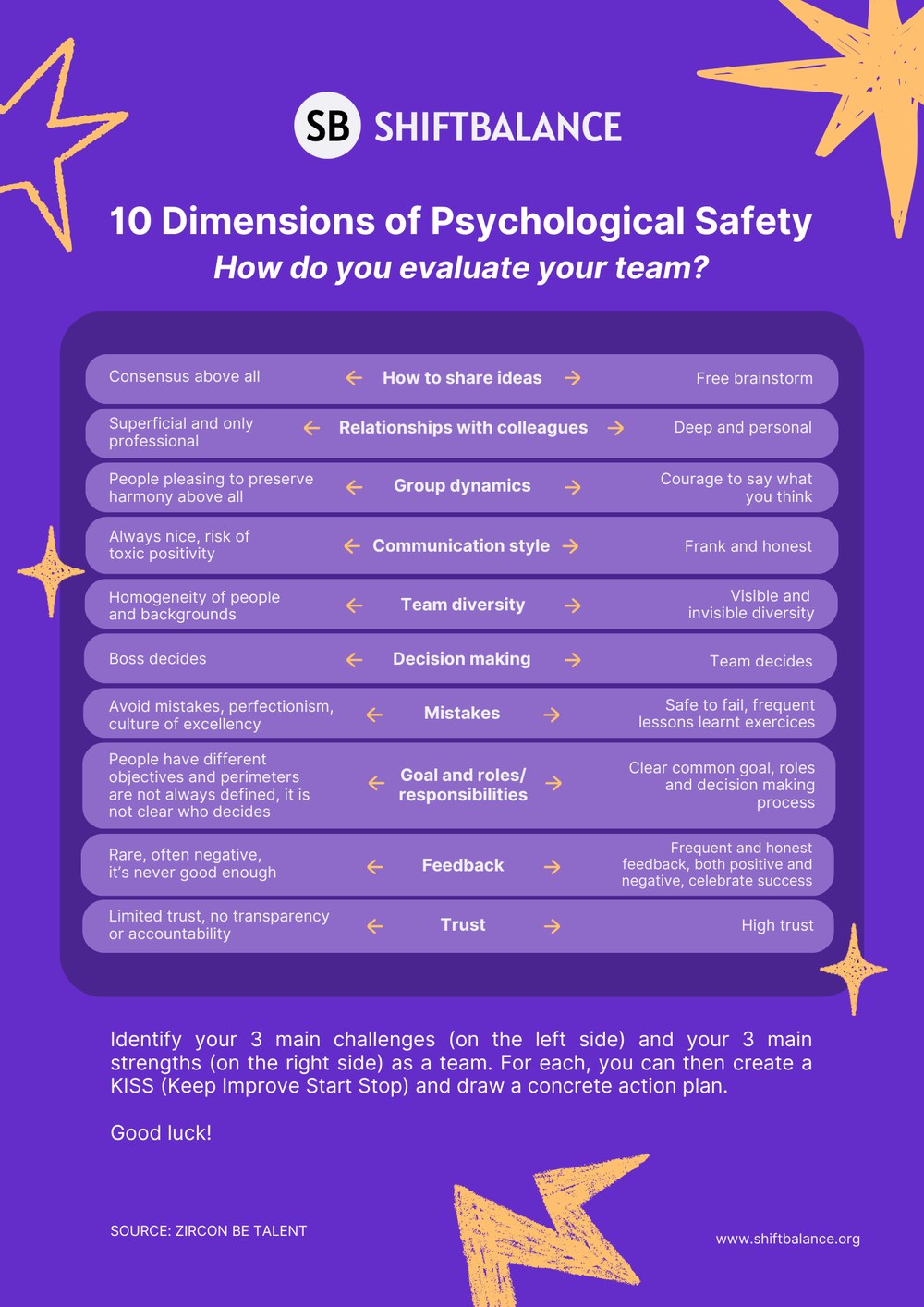
A practical lens: 10 dimensions of psychological safety

Psychological safety is not one behaviour. Teams experience it through multiple, connected dimensions: how ideas are shared, relationships, group dynamics, communication style, diversity, decision-making, responses to mistakes, clarity of goals and roles, feedback and trust. This 10-dimensions reflection tool helps teams identify where they are strong, where they are getting stuck and which behaviours to work on next.

Use it as a team conversation starter: identify your three strongest dimensions and your three biggest challenges, then translate them into concrete actions.

KeepImproveStartStop

Source framework credited in the tool to Zircon Be Talent.

Research and learning we connect to

We situate our practice within the wider psychological safety field and encourage clients to explore the original thinkers and frameworks alongside our applied tools:

Amy C. Edmondson

Psychological Safety
Foundational research on team psychological safety, interpersonal risk-taking, learning and candour.

Timothy R. Clark

The 4 Stages of Psychological Safety
A practical framework moving through Inclusion Safety, Learner Safety, Contributor Safety and Challenger Safety.

These references complement rather than replace the Shiftbalance methodology: we use established research as a foundation, then adapt the work to the organisation’s culture, power dynamics, geography, language, operating context and real moments of interpersonal risk.

Why organisations bring Shiftbalance into this work

We bring experience across UN agencies, INGOs and global companies, from organisation-wide learning programmes to Ombudsman-led work, manager coaching, team resets and high-pressure country contexts. The common thread is practical: understand where voice is being lost, work with the behaviours that shape it, and leave teams with tools and commitments they can continue using after the intervention.

Let’s talk

What is your team not saying yet?

If concerns arrive late, disagreement stays underground or managers are asking for more candour without getting it, start with the pattern – not another generic workshop.

Email us directly at susan@shiftbalance.org

    We’ll use these details only to respond to your enquiry.