
In almost every organisation I work with, people have a lot to say.
They see the risks. They notice when something is not working. They have ideas about what could be done differently. They know when a decision does not quite make sense.
The question is not whether they have something to say.
The question is whether they feel safe enough to say it.
Over the past few years, we have been asked to deliver psychological safety webinars, workshops, coaching and learning programmes for organisations including Chanel, UNFPA, WFP, Malaria Consortium, UNICEF, WHO and ActionAid, among others. Our work has ranged from organisation-wide programmes and e-learning to team conversations, manager training and individual coaching.
ChanelUNFPAWFPMalaria ConsortiumUNICEFWHOActionAid
And one pattern keeps coming back: organisations often call us when the silence has already become a problem.
When people have stopped challenging decisions. When hierarchy has become too strong to disagree with. When consensus is valued so highly that disagreement feels disruptive. When concerns are discussed privately after the meeting instead of openly during it.
By then, psychological safety is no longer an abstract culture topic. It is affecting how the organisation works.
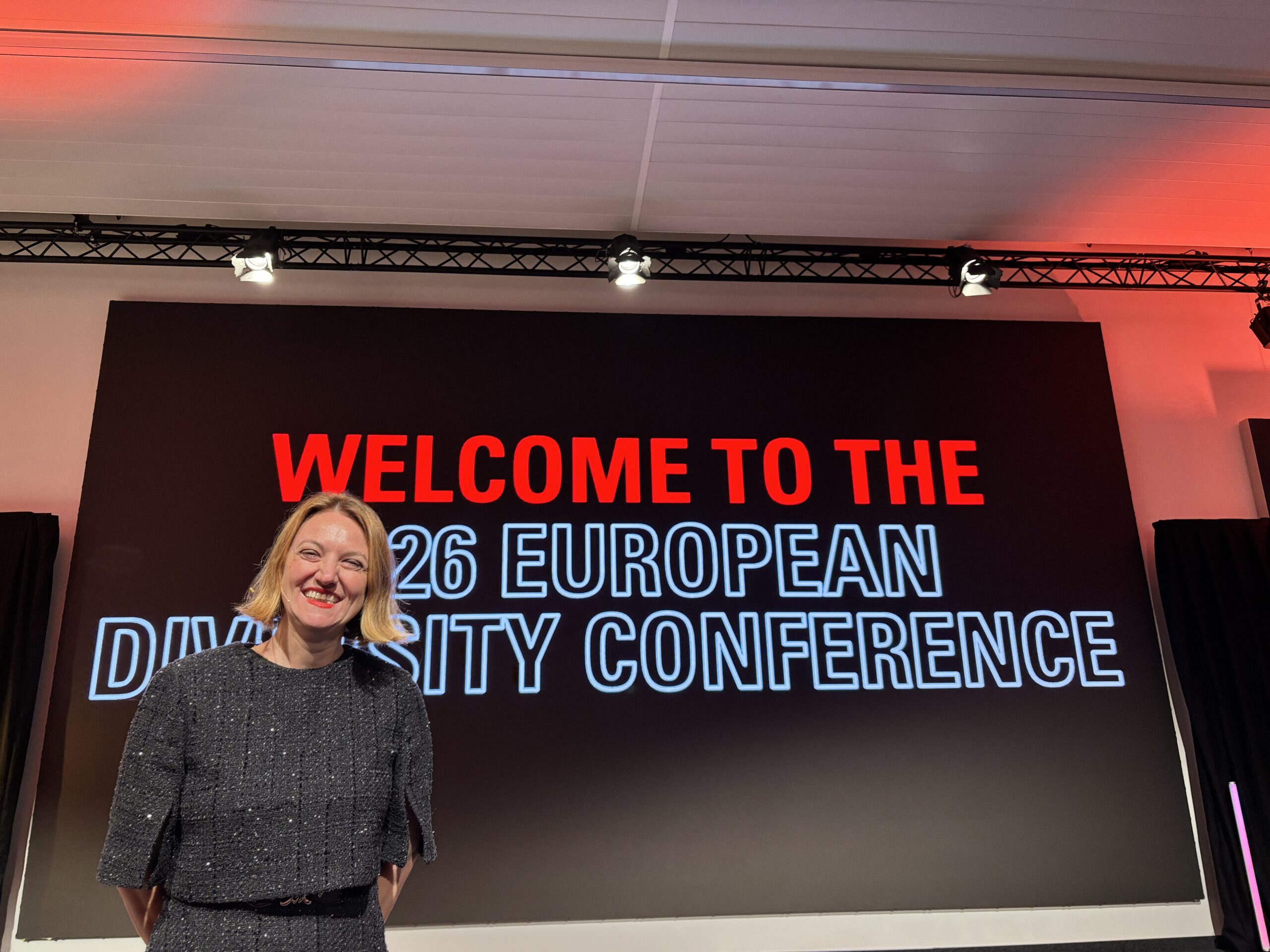
Aurélie Salvaire speaking on psychological safety at Toyota Europe, Brussels, October 2026.
Psychological safety is not about being nice
One of the biggest misunderstandings I encounter is that psychological safety means creating a workplace where everybody feels comfortable.
It doesn’t.
It does not mean lowering standards, avoiding difficult feedback or making sure nobody ever feels challenged. And it certainly does not mean that everyone needs to agree.
Amy Edmondson’s work on psychological safety has been influential in shaping how many of us understand this. At its heart, psychological safety is about whether people feel able to take interpersonal risks: to ask a question, admit a mistake, disagree, challenge an assumption or say, «I don’t know.»
For me, this distinction matters enormously. A psychologically safe team can still have high expectations. It can have difficult conversations. People can disagree strongly.
“In fact, I would worry about a team that never disagrees.”
The question is what happens when someone does. Do we become defensive? Does hierarchy suddenly take over? Does the person learn that challenging a decision comes at a cost? Or do we stay curious enough to hear what they are trying to tell us?
Speaking up becomes harder when power enters the room
This is also why our work with UNDP’s Speak-Up Training of Trainers has been so relevant to psychological safety. We supported internal facilitators to lead courageous conversations within their own teams, using a cascade approach that combined learning with real facilitation practice and one-to-one coaching feedback.
For me, speaking up is not only about confidence. It is about power. It is much easier to say what you think when everyone in the room has similar status. The real test comes when you need to disagree with someone more senior, question an accepted way of working, raise a concern that others would rather not hear, or say that a decision may be wrong.
That is where psychological safety and speaking up to power meet: not in encouraging people to be louder, but in changing the conditions around them so that candour does not come with an unnecessary personal cost.
Sometimes we are brought in too late
This is probably one of the strongest lessons from our work.
At Shiftbalance, we have worked on psychological safety in very different contexts.
With UNFPA, we developed an organisation-wide psychological safety programme combining self-paced e-learning with workshops delivered globally. With Chanel, we facilitated multiple team conversations exploring the current state of psychological safety and translating those conversations into future action plans. With Malaria Consortium, we delivered psychological safety sessions with teams and managers.
We have also supported WFP teams and managers in Afghanistan through psychological safety training and tailored leadership coaching, and worked for two years with WHO Europe’s Ukraine Country Office, supporting more than 70 staff through coaching around psychological safety, conflict, manager and peer tensions, performance and other difficult workplace situations.
More recently, our work with UNICEF Venezuela has included psychological safety and team dynamics alongside ethics and speak-up work.
These organisations are very different. The contexts are different. The pressure is different.
But the underlying challenge is often surprisingly similar.
People have learned, consciously or unconsciously, that some things are safer not to say.
Sometimes hierarchy is the issue. Sometimes it is a very strong culture of consensus. Sometimes a team has been through conflict or organisational change. Sometimes a manager genuinely wants people to speak openly but reacts defensively when someone finally does.
And sometimes everyone is being incredibly polite while the real conversation happens somewhere else.
“Consensus is not always evidence of psychological safety. Sometimes it is evidence that people have become very good at reading the room.”
From inclusion to challenge: the four stages of psychological safety
One framework I find useful for thinking about this is Timothy R. Clark’s Four Stages of Psychological Safety. The model describes psychological safety as developing through four stages:
|
1
Inclusion Safety
I feel accepted.
|
2
Learner Safety
I feel safe to learn.
|
|
3
Contributor Safety
I feel safe to contribute.
|
4
Challenger Safety
I feel safe to challenge.
|
For me, that fourth stage is where things become particularly interesting.
Many teams are comfortable inviting people in. Many say they value learning. Many actively ask employees to contribute. But what happens when contribution becomes challenge?
Can someone say, «I don’t think this is the right decision»? Can a junior colleague challenge a director? Can someone point out that the strategy is not working? Can the person who disagrees with everybody else stay in the conversation without being labelled difficult, negative or «not a team player»?
That tells me far more about psychological safety than a statement on a company website ever could.
Look at what happens in the small moments
Psychological safety is ultimately built in ordinary interactions.
Imagine someone tells their manager: «I think we may have made a mistake.»
The manager can say: «How did this happen?» Or: «Thank you for raising it early. What do we know, and what do we need to do next?»
Those responses may look like small differences in language. They are not. They teach people what happens when bad news travels upwards.
The same is true when someone disagrees in a meeting. When a colleague asks what they think is a «stupid» question. When someone says they are struggling. When an employee challenges a process that everyone else has accepted.
Culture is being created in those moments. People are constantly collecting evidence about what is safe here.
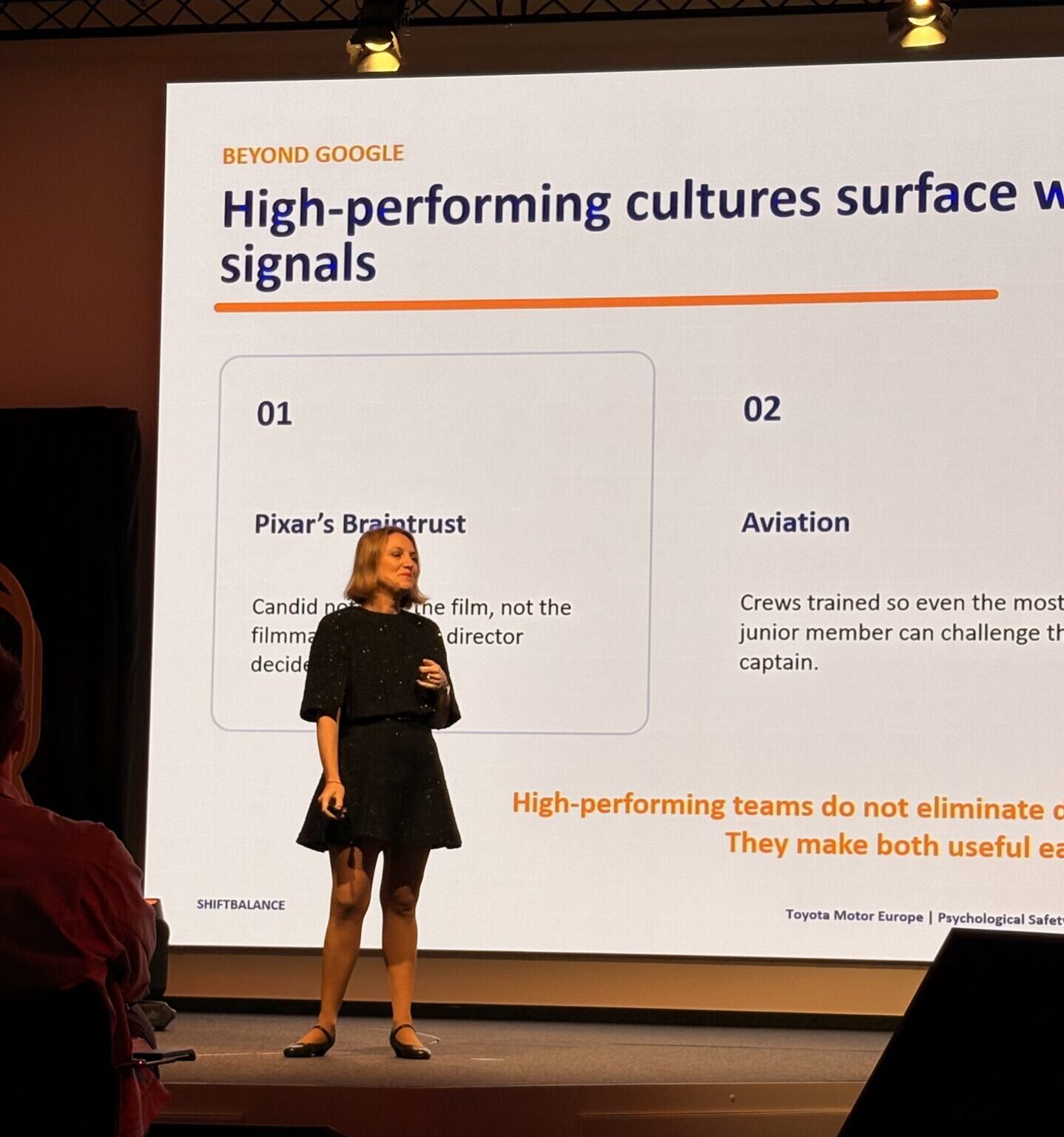
Exploring psychological safety with Toyota Europe, Brussels.
Ten dimensions: where is your team really?
Another tool we use looks at psychological safety through 10 practical dimensions of team life. Rather than asking simply, «Are we psychologically safe?», we can look at what is actually happening around:
| 1How ideas are shared | 2Relationships with colleagues |
| 3Group dynamics | 4Communication style |
| 5Team diversity | 6Decision-making |
| 7Mistakes | 8Goals, roles and responsibilities |
| 9Feedback | 10Trust |
The questions become much more concrete. Do ideas emerge through genuine brainstorming, or does consensus win too quickly? Can people say what they think, or is harmony protected at all costs? Does the boss decide, or is decision-making clear and appropriately shared? Are mistakes treated as failures to hide, or opportunities to learn? Is feedback frequent and honest, or rare and mostly negative? Is there clarity about roles, responsibilities and who actually makes which decisions?
And underneath all of this: is there trust?
I like this approach because it moves psychological safety away from being a vague aspiration and towards something a team can actually discuss. One simple exercise is to identify your team’s three strongest dimensions and three biggest challenges, then decide what you want to Keep, Improve, Start and Stop.
| KEEP | IMPROVE | START | STOP |
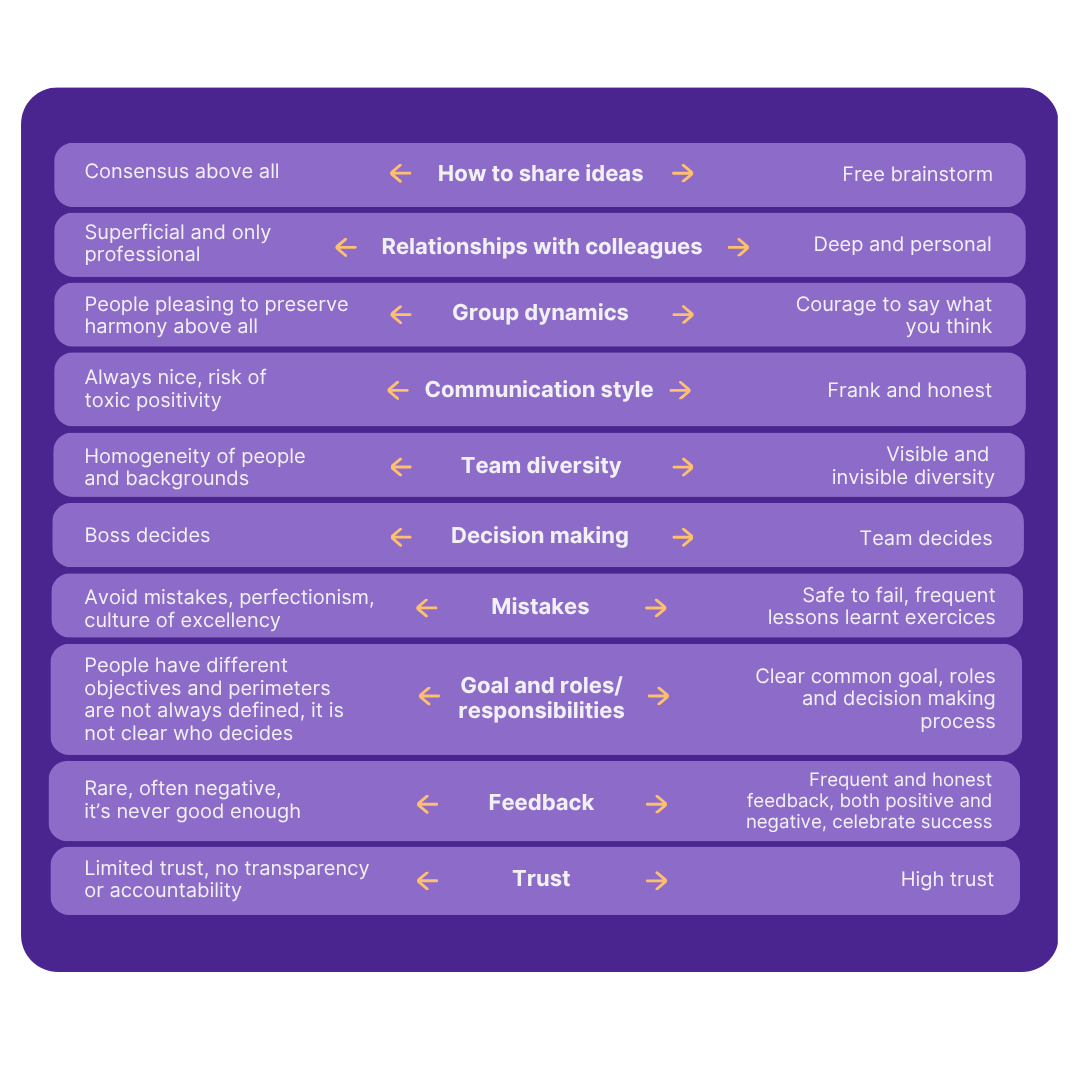
Shiftbalance 10 Dimensions of Psychological Safety tool. Source: Zircon Be Talent.
Psychological safety and accountability belong together
There is another misconception I want to challenge. Psychological safety is sometimes presented as though it sits on one end of a spectrum, with accountability and performance on the other. I don’t see it that way.
A team where people are afraid to raise problems is not a high-performing team simply because standards are high. And a team where everybody feels comfortable but nobody is accountable is not psychologically safe in any meaningful sense either.
“We need both candour and accountability.”
People need to know that they can admit a mistake. They also need to take responsibility for fixing it. They need to be able to challenge a decision. They also need to respect the eventual decision and understand who is accountable for making it. They need to be able to give honest feedback. And they need to be prepared to receive it.
That combination is much harder than simply telling people to «speak up.»
So where should leaders start?
Not with a poster saying Speak Up.
Start by paying attention to what happens when someone actually does.
?How do you respond to bad news?
?Who speaks first in your meetings? Who speaks last?
?Whose opinion tends to become the group’s opinion?
?When was the last time somebody openly disagreed with you? What happened afterwards?
?When somebody makes a mistake, is the first instinct to understand or to blame?
And perhaps the most important question:
“What do people on your team know, see or think that they are currently choosing not to tell you?”
That is where I would start.
Because the things we don’t say at work do not disappear. They simply show up somewhere else: in poor decisions, unresolved tensions, repeated mistakes, quiet disengagement or problems that become much harder to solve because nobody raised them early enough.
Psychological safety gives us the chance to have those conversations sooner.
And in my experience, sooner is almost always better.
Aurélie Salvaire is Founder & CEO of Shiftbalance. Shiftbalance works with organisations globally on psychological safety, inclusive leadership, organisational culture, ethics and change. Get in touch to explore how we can support your teams.